Grasses & Trees
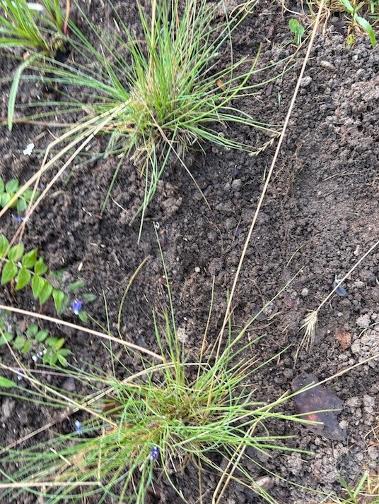
Sheep’s Fescue (Festuca ovina)
Several butterfly species rely on Sheep’s Fescue as a primary or essential foodplant for their caterpillars. The most notable of these include: Silver-spotted Skipper (this rare butterfly is restricted to short, south-facing chalk and limestone downland, where Sheep’s Fescue is its sole larval foodplant); Grayling (a heat-loving butterfly of coastal dunes, heaths and chalk downlands. Its caterpillars feed on a variety of fine grasses, strongly favouring Sheep’s Fescue); Small Heath (a widespread grassland species whose caterpillars feed on fine-leaved grasses, with Sheep’s Fescue being one of their primary food sources; Marbled White (while they prefer Red Fescue, these caterpillars will readily feed on Sheep’s Fescue).
Juniper (Juniperus communis Hibernian)
We are keen to grow Juniper. It is on the UK biodiversity action plan priority list as its populations have suffered a drastic decline across the country. Juniper trees have male and female flowers on separate plants. As colonies shrink and fragment, it becomes harder for pollen to reach female plants. Berries can take up to three years to ripen and seed viability drops significantly as bushes age. Overgrazing by deer and rabbits prevents seedlings from establishing and undergrazing allows aggressive scrub and dense woodland to crowd out light-loving Juniper.
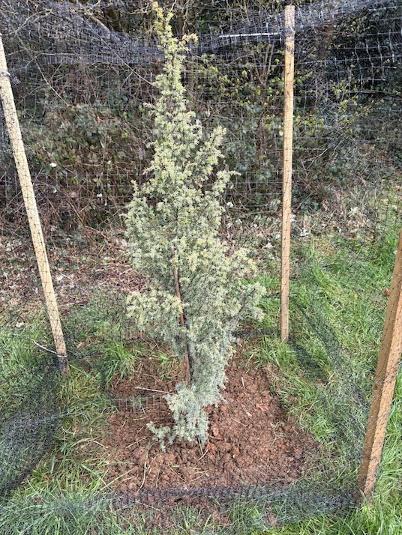
The four junipers we originally planted unfortunately turned out to be all male and did not grow well as they were heavily browsed by our deer. We have now added a beautiful female Juniper and all four trees (which are now protected by deer-proof fencing) are really flourishing.
Juniper’s berry-like seed cones are heavily relied upon by birds (such as Thrushes, Blackbirds and Waxwings) and mammals (like Foxes and mice) during the colder months when other food sources are scarce. Juniper supports over 50 specific insect species. Specialised bugs and insects such as the Juniper Shield Bug, Juniper Aphid and the Juniper Carpet Moth rely entirely on the plant to survive and its thick, spiny canopy provides a safe haven for small birds (like Stonechats) to build nests.
The four junipers we originally planted unfortunately turned out to be all male and did not grow well as they were heavily browsed by our deer. We have now added a beautiful female Juniper and all four trees (which are now protected by deer-proof fencing) are really flourishing.
Juniper’s berry-like seed cones are heavily relied upon by birds (such as Thrushes, Blackbirds and Waxwings) and mammals (like Foxes and mice) during the colder months when other food sources are scarce. Juniper supports over 50 specific insect species. Specialised bugs and insects such as the Juniper Shield Bug, Juniper Aphid and the Juniper Carpet Moth rely entirely on the plant to survive and its thick, spiny canopy provides a safe haven for small birds (like Stonechats) to build nests.